

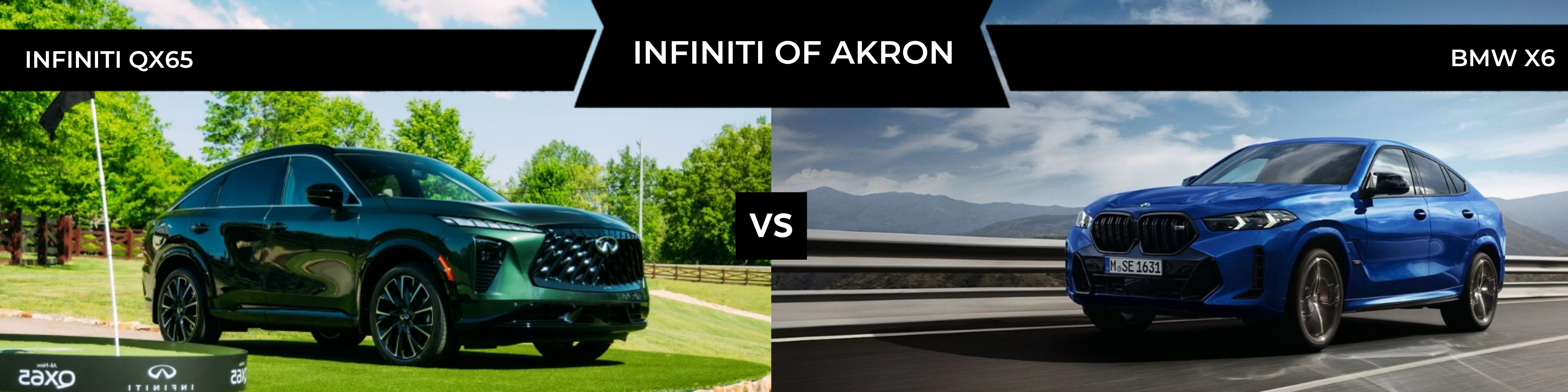
INFINITI QX65
vs. BMW X6
Two fastback SUVs built for the same buyer — one asks $23,000 more for the privilege. Here is a full, honest analysis of every dimension that matters: performance, cargo, technology, ownership costs, and long-term value.
Same Fastback Vision. Very Different Price Tags.
The coupe-SUV segment exists because buyers refused to choose between style and utility — and both the INFINITI QX65 and the BMW X6 represent that philosophy at its most committed. Both wear dramatic raked rooflines. Both seat five adults in genuine luxury. Both are all-wheel drive. And yet these two vehicles land in very different places when you examine what you're actually getting for your money.
It's worth noting that INFINITI's history in this segment predates the X6. The brand's FX series — launched in 2003 — established the low-roof, sport-tuned luxury SUV formula that the broader market eventually followed. The QX65 is a direct descendant of that lineage, and it brings with it a sensibility that prioritizes interior practicality alongside athletic proportions. BMW refined the formula and priced it accordingly. INFINITI is now making the case that refinement doesn't have to cost this much.
In the analysis below, we cover every major dimension: purchase price, powertrains, cargo and practicality, infotainment technology, driver assistance, warranty coverage, ownership costs, and who each vehicle is actually built for. If you're cross-shopping these two in the Akron area, this is the comparison you need.
Side-by-Side Numbers
| Specification | INFINITI QX65 | BMW X6 xDrive40i |
|---|---|---|
| Starting MSRP | $53,990 ✓ | $77,300 |
| Engine | 2.0L VC-Turbo I-4 | 3.0L Turbo I-6 ✓ |
| Horsepower | 268 hp | 375 hp ✓ |
| Torque | 286 lb-ft | 398 lb-ft ✓ |
| 0–60 mph | TBD (est. ~6.5 sec) | ~5.2 sec ✓ |
| Drivetrain | AWD Standard | AWD Standard |
| Seating Capacity | 5 Passengers | 5 Passengers |
| Cargo — Behind Row 2 | 35.8 cu ft ✓ | 27.4 cu ft |
| Cargo — Seats Folded | 67.7 cu ft ✓ | 59.6 cu ft |
| Fuel Economy (combined) | 22 mpg est. | 24 mpg ✓ |
| Google Built-In | Standard ✓ | Not Available |
| Wireless CarPlay / Android Auto | Standard | Standard |
| Panoramic Sunroof | Standard | Standard |
| Wireless Phone Charging | Qi2 Standard ✓ | Available (add-on) |
| Driver Assistance Suite | ProPilot Standard | Driving Assist Std. |
| Towing Capacity | 6,000 lbs | ~6,000 lbs |
| Assembly | Smyrna, TN — USA ✓ | Leipzig, Germany |
| Basic Warranty | 4 yr / 60,000 mi ✓ | 4 yr / 50,000 mi |
The Engine Story: Where BMW Has the Edge — and Why It May Not Matter
This is the one area where the BMW X6 wins clearly and convincingly. The xDrive40i's 3.0-liter turbocharged inline-six produces 375 horsepower and 398 lb-ft of torque — numbers that translate to a 0–60 mph sprint of around 5.2 seconds. That is genuinely fast for a vehicle this size, and the BMW inline-six is among the smoothest, most characterful engines currently in production. It revs cleanly, sounds good under hard acceleration, and delivers power in a linear, satisfying way. If engine performance is your top priority, the X6 deserves credit here.
The QX65 pairs a 2.0-liter VC-Turbo four-cylinder with 268 horsepower and 286 lb-ft of torque. That engine is one of the more interesting pieces of engineering in the segment — INFINITI's Variable Compression Turbo technology adjusts the compression ratio on the fly, optimizing between performance and efficiency in a way that conventional engines cannot. It is more sophisticated mechanically than the displacement figure alone suggests. That said, on paper it is slower, and real-world testing will bear that out.
The honest question is how often that gap actually matters. Both vehicles produce enough power to merge confidently, pass on the highway, and carry five adults with cargo at highway speeds. For daily driving in and around Akron — including highway commutes and occasional road trips — 268 horsepower is genuinely sufficient. The buyers who will notice the BMW's advantage most are those who specifically seek out on-ramps and back roads. For everyone else, the QX65's engine is adequate and the $23,000 savings is real money that can be directed elsewhere.
One additional consideration: the VC-Turbo architecture gives the QX65 efficiency headroom that a larger displacement engine does not have. As fuel prices fluctuate, a smaller, technologically advanced engine can be an asset over the full ownership period.
2.0L VC-Turbo I-4
268 hp · 286 lb-ft · Variable compression technology adjusts dynamically for efficiency or performance. Technologically advanced for its class.
3.0L Turbo Inline-Six
375 hp · 398 lb-ft · One of the best inline-sixes in the industry. Smooth, powerful, and quick. Clear performance leader in this comparison.
The QX65 Carries More — by a Significant Margin
This is one of the most important and least glamorous parts of the comparison. The fundamental tension in any coupe-SUV is that the sloping roofline — the feature that makes these vehicles look distinctive — costs you cargo room. Both the QX65 and the X6 accept that tradeoff, but INFINITI has managed it considerably better.
Behind the second row, the QX65 delivers 35.8 cubic feet of cargo space. The BMW X6 offers 27.4 cubic feet. That is a difference of 8.4 cubic feet — roughly the volume of four carry-on suitcases. Fold the rear seats and the gap widens: 67.7 cubic feet for the QX65 versus 59.6 cubic feet for the X6. In practical terms, this means the QX65 can handle a Costco run, a family weekend trip, or airport pickups for multiple travelers without compromise, in situations where the X6 would leave bags in laps.
This matters in particular for buyers who are stepping down from a traditional box-SUV — a QX60, an Acura MDX, a Toyota Highlander — and considering a fastback body style for the first time. The QX65's cargo numbers are close enough to conventional midsize SUVs that the transition isn't painful. The X6's numbers are tighter, and you feel it.
Both vehicles seat five adults, and rear-seat legroom is competitive at this class level. Neither offers a third row, which is a deliberate tradeoff inherent to the coupe-SUV form factor. If a third row is on your requirements list, neither vehicle is the right choice; if it isn't, the QX65 carries more of everything else.
Google Built-In Changes the Infotainment Conversation
The infotainment gap between these two vehicles is larger than a spec sheet suggests. BMW's iDrive system is genuinely accomplished — it is visually polished, responsive, and reasonably intuitive for owners who invest time learning it. The curved display architecture in the X6 is one of the more impressive-looking cockpits in the segment. But iDrive runs BMW's proprietary software ecosystem, and that ecosystem has limits that matter in daily use.
The QX65 ships with Google Built-In as a standard feature on every trim. This is not Android Auto projection over a cable or wirelessly — it is the full Google operating environment running natively inside the vehicle. Google Maps is the navigation system, which means live traffic, accurate ETAs, lane guidance, and the continuous updates that Google pushes to its mapping platform. Google Assistant handles voice commands with the accuracy and breadth that drivers already rely on from their phones. Google Play provides access to streaming apps, audiobooks, podcasts, and media directly through the vehicle's speakers and screen without requiring a phone connection at all.
For many buyers, this is the feature that ends the conversation. The navigation alone — the difference between Google Maps and a manufacturer's in-house mapping system — is tangible every single day. Commuters who drive in and out of Cleveland, families heading to Pittsburgh or Columbus on weekends, anyone who drives in places where road conditions change: they will notice the quality of the mapping data on every trip.
Both vehicles offer wireless Apple CarPlay and wireless Android Auto, which partially closes the gap. But wireless projection introduces occasional lag, and it still requires your phone to be present and connected. Google Built-In works independently — and it keeps working when your phone battery is dead, when you forget your phone at home, or when you hand the car keys to someone else entirely.
The QX65 also ships with Qi2 wireless phone charging as standard equipment. On the X6, wireless charging is a paid option. These are the kinds of line items that add up quickly when configuring a BMW — and the QX65 bundles them into a base price that already starts $23,000 lower.
ProPilot vs. BMW Driving Assist: Real-World Differences
Both vehicles come equipped with standard driver assistance packages, but the capabilities are worth comparing in detail. INFINITI's ProPilot system — standard on the QX65 — combines adaptive cruise control with lane centering to manage both speed and lateral position on the highway. In stop-and-go traffic and on highway cruises, the system handles the primary driving workload while the driver monitors the road. It's a meaningful reduction in fatigue on longer trips.
BMW's Driving Assist package provides similar core functionality: adaptive cruise with stop-and-go capability, lane departure warning, and lane keeping assist. BMW's implementation benefits from the brand's software investment and is well-regarded by owners. At the base trim level, both systems are competitive. The QX65's advantage is that ProPilot is standard from the first trim — you don't need to option up to access it.
Both vehicles also include standard automatic emergency braking, blind spot monitoring, rear cross-traffic alert, and parking sensors. These safety nets are now expected in this price segment, and both manufacturers deliver them.
The QX65's Financial Advantage Compounds Over Time
The starting price gap between these vehicles is $23,310. But the full financial picture over five years of ownership is wider than that number alone.
The QX65 carries a basic warranty of 4 years and 60,000 miles. The BMW X6's basic warranty covers 4 years and 50,000 miles — 10,000 fewer miles on a vehicle that costs substantially more to repair when it does need service. BMW is known for higher service costs than Japanese luxury brands, and while both vehicles benefit from free scheduled maintenance in their first years, the total cost picture over a 100,000-mile ownership period tends to favor INFINITI.
Insurance costs also typically track with vehicle price. A $53,990 vehicle will generally carry lower insurance premiums than a $77,300 vehicle in the same class. Over five years, that difference — combined with the acquisition price gap — represents a meaningful sum.
Perhaps most importantly: both vehicles depreciate. Luxury vehicles in the $50,000–$80,000 range typically retain between 45–55% of their value over five years. The QX65 buyer started from a lower base, which means their absolute depreciation exposure is lower. The X6 buyer paid more for a vehicle that will also shed a large percentage of its value — meaning they paid the premium twice: once at purchase and once in depreciation losses.
None of this means the X6 is a bad vehicle. It means that the QX65 represents a more efficient use of capital for a buyer who wants premium-segment styling, features, and build quality without paying for the BMW badge at a rate that doesn't return value over time.
Five Clear Advantages Over the BMW X6
Who Should Buy Each Vehicle
Value + Practicality Win
You want the fastback SUV experience without overpaying for it. You use your navigation every day. You need real cargo room for family life. You drive Ohio winters and want AWD without negotiating for it. You plan to keep the vehicle past 50,000 miles and want warranty coverage to match.
Performance Is Non-Negotiable
Outright engine power and BMW's driving dynamics are your top priorities. You specifically want the BMW badge and the prestige it carries. Budget is not a constraint, and you prioritize the inline-six performance experience above all other factors.
INFINITI QX65 over BMW X6 — for Most Buyers
The BMW X6 is a genuinely excellent machine. Its inline-six is one of the best engines in the industry, its chassis dynamics are sharp, and the cabin is impressively built. If raw performance is the only thing that matters, it earns its price of admission.
But the INFINITI QX65 delivers more cargo room, a better infotainment system, a longer warranty, American assembly, and standard Qi2 wireless charging — all at $23,000 less with AWD already included. For the vast majority of buyers in Akron who want a premium fastback SUV for daily driving, family use, and Ohio winters, the QX65 is the smarter, more complete purchase at every trim level.
INFINITI QX65 vs. BMW X6 — FAQ
Experience the QX65 at INFINITI of Akron
Visit us to see the all-new QX65 in person. Our team will walk you through every trim and feature — no pressure, no games. If you're coming from a BMW, a Mercedes, or any other luxury brand, we'll show you what $23,000 in savings actually looks like in the real world.